
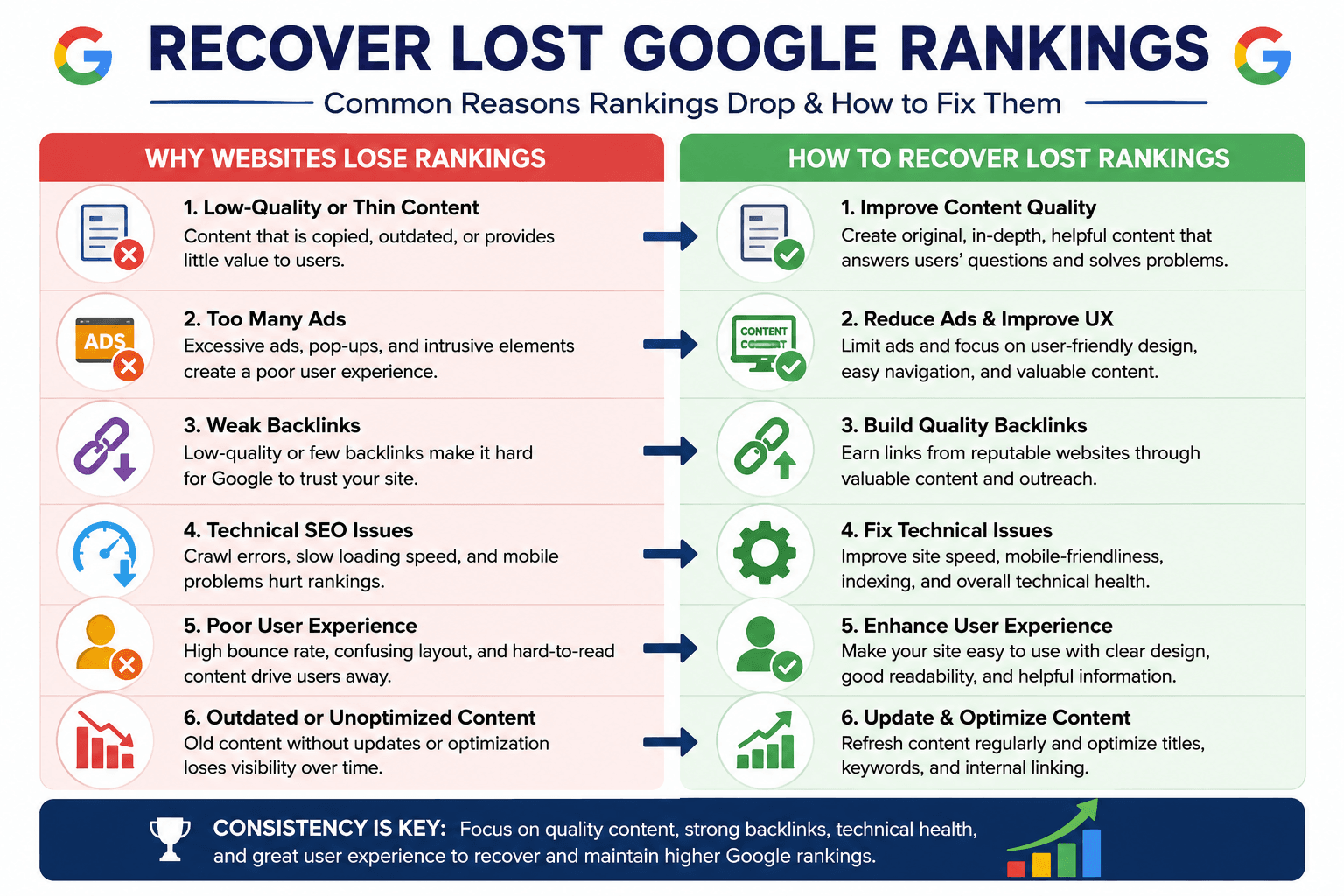
Recover lost Google rankings by improving your website’s content, technical SEO, and overall user experience. If your site has suddenly dropped in search results, this guide explains the most common causes and the practical steps you can take to regain your visibility.
Every website owner wants better visibility in Google Search, but improving search rankings has become more challenging as Google’s algorithms continue to evolve. Updates that reward high-quality content and better user experiences have replaced many of the older SEO tactics that once worked.
One of the most significant changes occurred with the introduction of the Google Panda update. Panda fundamentally changed the way Google evaluated websites by rewarding valuable, original content while reducing the visibility of pages that provided little value to users.
Although Panda is now part of Google’s broader ranking systems, its core principles remain just as important today. This guide explains how to improve your website’s SEO, recover lost Google rankings, and build a stronger online presence by focusing on content quality, technical optimization, and user experience.
Why Websites Lose Google Rankings
Many businesses assume a ranking drop is caused by a single problem. In reality, it’s often the result of several factors working together.
Common reasons include:
- Thin or outdated content.
- Duplicate pages.
- Poor user experience.
- Slow page speed.
- Weak backlink profiles.
- Technical SEO issues.
- Declining content quality.
Understanding why rankings change is the first step toward improving them.
1. Improve the Quality of Content on Your Website
One of the biggest reasons websites lost rankings after the Panda update was low-quality content.
Many sites relied on:
- Copied articles from other websites
- Thin content with little value
- Keyword-stuffed pages
- Automated or low-effort writing
Google now prioritizes content that is:
- Original
- Helpful
- Well-structured
- Informative
- Engaging for users
Why content quality matters
Search engines have evolved to measure user satisfaction. If users click on your page and immediately leave, Google interprets that as a sign of poor content quality.
To recover or improve rankings, you must focus on publishing high-value content consistently.
How to improve your content
High-quality content should answer a visitor’s questions completely rather than simply repeating keywords. Articles that provide practical advice, examples, images, and well-organized headings generally perform better because they create a more satisfying user experience.
Rather than publishing many short articles, consider creating comprehensive guides that become long-term resources for your audience.
- Write in-depth articles that fully answer user questions
- Avoid copying content from other sources
- Use clear headings and structure
- Add practical examples and explanations
- Focus on solving real problems
High-quality content is the foundation of modern SEO success.
Keep Existing Content Updated
Google generally prefers content that remains accurate and useful.
Review older articles regularly and update:
- Statistics
- Screenshots
- Broken links
- Outdated recommendations
- New industry developments
Refreshing valuable content often improves both user experience and search performance.
2. Limit the Number of Ads on Your Website
Another major factor that caused ranking drops during the Panda update was overuse of advertising.
Websites that prioritized ads over content were heavily penalized because they created a poor user experience.
Pages filled with:
- Excessive banner ads
- Pop-ups covering content
- Distracting ad placements
- Minimal actual information
were often pushed down in rankings.
Why ad balance matters
Google wants users to find information quickly and easily. If a page is overloaded with ads, it reduces readability and increases bounce rates.
Best practices for ad placement
- Keep ads minimal and non-intrusive
- Ensure content is always the primary focus
- Avoid placing too many ads above the fold
- Balance monetization with user experience
A well-structured page should prioritize information first, advertising second.
3. Focus on Organic Backlinks Instead of Paid Links
Backlinks remain one of the most important ranking factors in SEO. However, not all backlinks are equal.
Remember that quality matters far more than quantity.
One relevant backlink from a respected industry website can provide significantly more value than dozens of low-quality links from unrelated sources.
Building authority takes time, but natural backlinks remain one of the strongest long-term SEO signals.
Websites with low-quality or unnatural backlinks saw significant ranking drops, while sites with strong, natural backlinks maintained or improved their positions.
What are low-quality backlinks?
- Links from irrelevant websites
- Paid or spammy link networks
- Automated link-building schemes
- Poor authority domains
What are high-quality backlinks?
- Links from trusted, authoritative websites
- Relevant industry-related sources
- Editorially earned mentions
- Natural references within content
The right strategy
Instead of buying backlinks or using shortcuts, focus on building organic backlinks by:
- Publishing valuable content others want to reference
- Guest posting on relevant websites
- Creating shareable resources or guides
- Building relationships within your industry
Organic backlinks signal trust and authority to Google, which improves long-term rankings.
4. Improve Technical SEO
Even excellent content can struggle if a website has technical problems.
Review your website for:
- Fast loading pages.
- Mobile responsiveness.
- Secure HTTPS connections.
- Clear navigation.
- Internal linking.
- Optimized images.
- Structured data (schema markup).
Technical improvements make it easier for both visitors and search engines to navigate your website.
What to check regularly
- Broken links
- Missing or empty pages
- Slow page load speeds
- Duplicate content issues
- Mobile usability problems
- Outdated content
Why this matters
Google prioritizes websites that are:
- Technically healthy
- Easy to navigate
- Consistently updated
If your website has unresolved issues, it can negatively impact your rankings even if your content is high quality.
Regular audits ensure your site remains optimized and competitive.
Measure Your SEO Progress
SEO improvements should always be measured.
Track important metrics such as:
- Organic traffic.
- Keyword rankings.
- Click-through rate.
- Time on page.
- Bounce rate.
- Conversion rate.
These measurements help identify which improvements are producing meaningful results. When done correctly you can recover lost Google rankings.
5. Improve User Experience Across Your Website
Beyond content and backlinks, user experience (UX) plays a major role in modern SEO.
Google evaluates how users interact with your website, including:
- Time spent on page
- Bounce rate
- Navigation behavior
- Mobile usability
Ways to improve UX
- Make navigation simple and clear
- Use readable fonts and clean design
- Improve mobile responsiveness
- Organize content logically
- Reduce clutter and distractions
A website that is easy to use naturally performs better in search rankings.
6. Focus on Long-Term SEO Strategy, Not Shortcuts
One of the biggest lessons to learn is that shortcuts do not work in SEO.
Tactics like:
- Keyword stuffing
- Duplicate content
- Spam backlinks
- Thin pages
- Over-optimization
are no longer effective and can actively harm your rankings.
Instead, long-term SEO success depends on:
- Consistent content creation
- Strong site structure
- Ethical link building
- User-focused optimization
SEO today is about building trust with both users and search engines.
Final Thoughts: Build for People First
Google’s algorithms have changed dramatically over the years, but one principle has remained consistent: websites that provide genuine value to visitors tend to perform better over the long term.
Rather than chasing algorithm updates or searching for shortcuts, focus on publishing original content, improving user experience, maintaining technical SEO, and building authority naturally.
Businesses that consistently invest in quality create websites that not only recover from ranking losses but continue growing regardless of future algorithm updates.
At LinkTargeter, we believe successful SEO begins with helping real people. When your website solves problems, answers questions, and provides valuable information, stronger search visibility often follows naturally.
Frequently Asked Questions
What was the Google Panda update?
The Google Panda update was a major algorithm change introduced to improve search quality by rewarding valuable, original content and reducing the visibility of low-quality pages.
Can a website recover from ranking losses?
Yes. Improving content quality, fixing technical issues, building natural backlinks, and enhancing user experience can help websites regain visibility over time.
How long does SEO recovery take?
Recovery varies depending on the issues involved and the level of improvement made. SEO is generally a long-term process rather than an immediate fix.
Is content still the most important SEO factor?
High-quality content remains one of the most important ranking factors, especially when combined with strong technical SEO and a positive user experience
Continue Reading
- A Practical Guide to Building a Successful Online Advertising Strategy
- Why Conversions Matter More Than Clicks
- Cheap Advertising That Drives Website Sales
- Why Digital-Only Marketing Delivers Better ROI
About LinkTargeter
LinkTargeter helps businesses grow online through affordable, sales-focused website advertising. We specialize in increasing website visibility, attracting qualified visitors, and helping businesses build sustainable long-term growth through effective digital marketing strategies.