
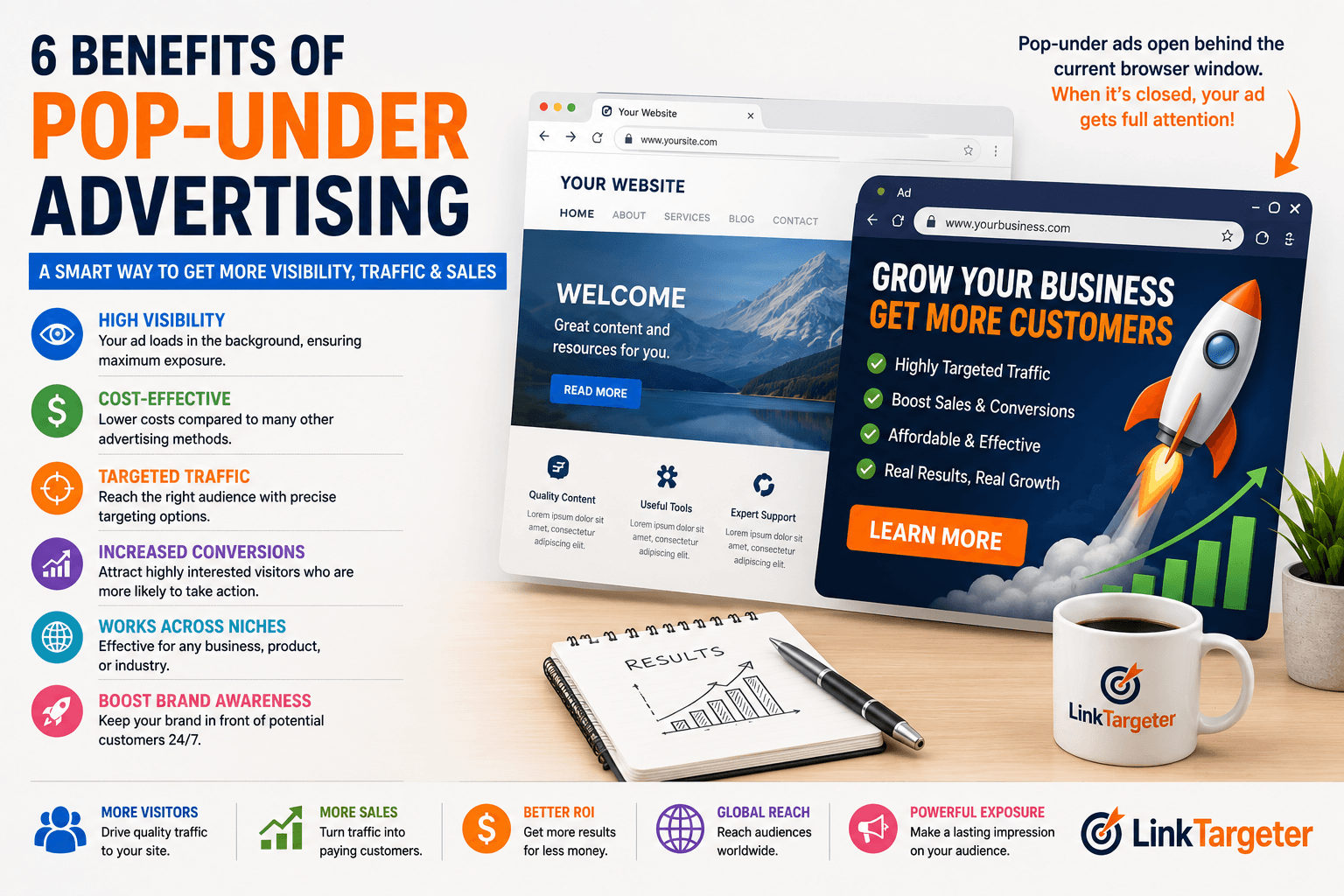
6 Benefits of Pop-Under Advertising
Pop-under advertising has been part of digital marketing for many years. While newer advertising formats have emerged, pop-under ads continue to be used by some businesses because they can provide broad exposure, fast campaign launches, and cost-effective traffic.
Like any advertising method, pop-under advertising is not the right choice for every campaign. Its effectiveness depends on audience targeting, campaign goals, landing page quality, and how it fits within an overall marketing strategy.
This guide explains how pop-under advertising works, its advantages, its limitations, and when businesses should consider using it.
So, what actually makes pop-under advertising such a great advertising medium? Now take a look at the top 6 reasons below for pop under advertising’s remarkable success in the online advertising world.
1. Lasting Brand Exposure
One reason some advertisers choose pop-under advertising is that the advertisement often remains open after the visitor finishes browsing another website.
When the user eventually closes their browser or returns to the hidden tab, the advertisement becomes visible, creating another opportunity to capture attention.
Although this doesn’t guarantee engagement, it can increase brand awareness compared with advertising formats that disappear immediately.
Many businesses like Google Ads, which is not a reasonably cheap option.
2. Reach a More Relevant Audience
One of the greatest advantages of pop-under advertising is the ability to display ads on websites that are relevant to your business or industry. Rather than showing advertisements to a broad audience with varying interests, campaigns can often be targeted toward visitors who are already reading about related topics or researching similar products and services.
For example, a company selling automotive accessories may choose to advertise on automotive blogs or enthusiast websites. Likewise, a travel business may benefit from placements on vacation planning or travel-related websites. When the advertising environment closely matches the advertiser’s niche, visitors are generally more likely to recognize the relevance of the offer.
Targeted placement helps improve the quality of website visitors by reaching people who already have an interest in the subject matter. While no advertising method guarantees conversions, presenting advertisements to a more relevant audience often leads to better engagement and a greater opportunity to generate qualified leads.
3. Immediate Website Visibility
Unlike search engine optimization, which often takes weeks or months to produce significant results, pop-under advertising can begin delivering visitors shortly after a campaign launches. This makes it an attractive option for businesses that want to increase website visibility quickly.
Immediate exposure can be particularly valuable when launching a new website, promoting a seasonal sale, introducing a new product, or testing a marketing campaign. Businesses receive feedback much faster, allowing them to evaluate campaign performance and make adjustments if necessary.
Although immediate traffic does not automatically guarantee sales, it provides valuable data that can help businesses refine their advertising strategy and identify which offers, landing pages, and audiences perform best.
4. Affordable Advertising for Many Businesses
Cost is one of the primary reasons many businesses explore pop-under advertising. Compared with some forms of online advertising that rely on competitive bidding systems, pop-under campaigns can often provide a large number of impressions or visitors at a relatively affordable cost.
This lower cost allows businesses with limited marketing budgets to experiment with online advertising without committing significant financial resources. Startups, small businesses, and independent website owners often appreciate the ability to test campaigns while carefully managing expenses.
As with any advertising investment, success depends on campaign quality, audience targeting, and the effectiveness of the landing page. Affordable advertising works best when it is combined with a clear marketing strategy rather than simply focusing on generating the highest volume of traffic.
5. Flexible Campaign Management
One of the strengths of digital advertising is the ability to make changes quickly, and pop-under advertising is no exception. Advertisers can often update landing page URLs, modify campaign budgets, adjust targeting options, or pause campaigns with very little delay.
This flexibility allows businesses to respond to changing market conditions or improve campaign performance as new data becomes available. If one landing page performs better than another, advertisers can redirect traffic accordingly without waiting for a campaign to end.
The ability to test different offers, headlines, and landing pages also helps businesses learn which strategies produce the strongest results. Over time, these improvements can increase conversion rates while making advertising budgets more efficient.
6. Supports a Diversified Marketing Strategy
Pop-under advertising is most effective when it is used as one component of a broader digital marketing strategy rather than the only source of website traffic. Successful businesses often combine multiple advertising channels to reduce dependence on any single platform.
For example, a business might use search engine optimization to generate long-term organic traffic, content marketing to build authority, social media to engage customers, and pop-under advertising to increase short-term visibility. Each channel serves a different purpose while supporting overall business growth.
Diversifying traffic sources also reduces risk. Changes to search engine algorithms, advertising costs, or user behavior can affect any single marketing channel. By using several complementary strategies, businesses create a more stable and sustainable approach to attracting visitors and generating customers.
Overall, the positive benefits of pop-under advertising cannot be disputed. Through precisely targeted pop under campaigns, advertisers can gain from instant increase in targeted website traffic at some of the most affordable prices on the internet.
What Is Pop-Under Advertising?
Pop-under advertising displays a new browser window or tab behind the visitor’s current browser window. Unlike pop-up ads that appear immediately in front of the user, pop-under ads remain hidden until the user closes or minimizes their current browser.
Because they don’t interrupt browsing in the same way, some advertisers use pop-under ads to increase visibility while reducing immediate disruption.
Potential Limitations of Pop-Under Advertising
Businesses should also understand the challenges associated with pop-under advertising.
Possible limitations include:
- Some browsers restrict pop-under windows.
- Some users dislike this advertising format.
- Conversion rates depend heavily on targeting.
- Landing page quality remains critical.
- Not every industry is well suited to pop-under campaigns.
Understanding these limitations helps advertisers make informed decisions.
Best Practices for Pop-Under Advertising
Successful campaigns usually include:
- Highly relevant targeting.
- Clear landing pages.
- Strong calls to action.
- Mobile-friendly websites.
- Performance monitoring.
- Ongoing optimization.
Like any advertising strategy, testing and refinement are essential for long-term success.
How LinkTargeter Uses Targeted Website Advertising
Instead of relying solely on one advertising format, LinkTargeter focuses on helping businesses reach relevant audiences through carefully selected website placements and affordable online advertising opportunities.
By emphasizing audience relevance, campaign flexibility, and measurable results, businesses can build advertising campaigns that support long-term growth rather than simply increasing traffic numbers.
Final Thoughts
Pop-under advertising continues to be one of many tools available to digital marketers.
When combined with relevant targeting, quality landing pages, and realistic campaign expectations, it can help businesses increase visibility and generate additional website traffic.
However, no single advertising method should be viewed as a complete marketing solution. The strongest results usually come from combining multiple strategies, including:
- Search engine optimization
- Content marketing
- Referral traffic
- Contextual advertising
- Affordable website advertising
- Conversion optimization
Businesses that diversify their marketing efforts are generally better positioned for long-term success.
Frequently Asked Questions
What is pop-under advertising?
Pop-under advertising opens a new browser window or tab behind the user’s current window, allowing the advertisement to appear after the user finishes browsing.
Is pop-under advertising still effective?
It can be, particularly when campaigns are well targeted and aligned with relevant audiences. Results vary depending on industry, campaign goals, and user behavior.
Is pop-under advertising expensive?
Many advertisers use pop-under campaigns because they can provide broad exposure at relatively affordable costs compared with some other online advertising methods.
Should small businesses use pop-under advertising?
It depends on their audience, products, and marketing objectives. Many businesses benefit from testing pop-under advertising alongside other digital marketing strategies.
Related Articles
- Cheap Advertising That Drives Website Sales
- Why Conversions Matter More Than Clicks
- A Practical Guide to Driving Sales, Not Just Traffic
- Affordable Advertising for Small Businesses
About LinkTargeter
Use the same “About LinkTargeter” section you’ve added to the other articles so everything stays consistent across the blog.